Buried No Longer. Jewish-Austrian History in Vienna´s Malzgasse Kopie
Forensic arrangement
Exhibition architecture at House of Austrian History, Vienna (AT), until April 6, 2021
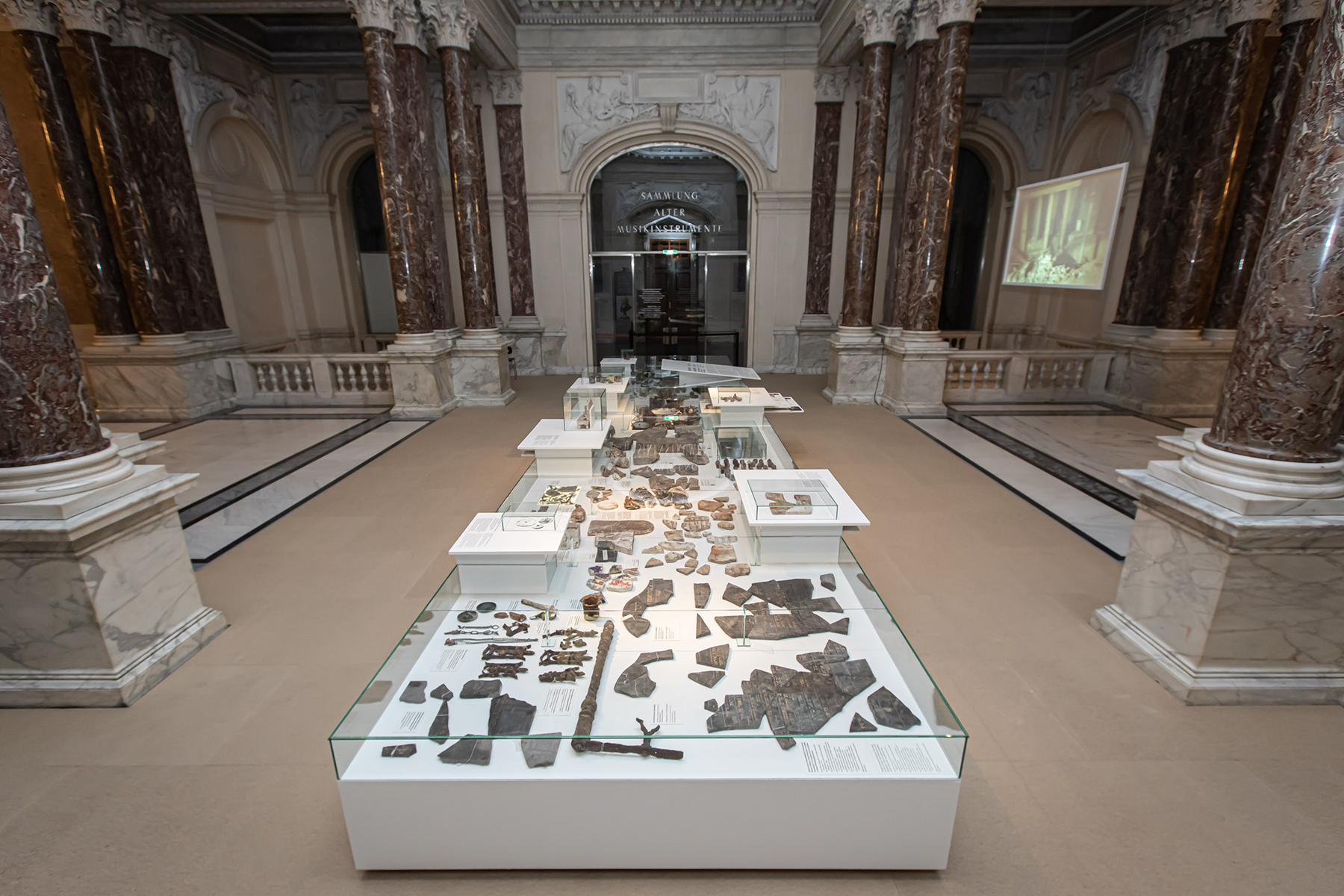
For decades, a cellar kept the moment of the destruction of the synagogue at Malzgasse 16 during the November pogrom of 1938 tightly closed and stored. It was only in the course of renovation work that the relics and evidence of this act of violence were discovered and recovered from the burial: memorial stones from the synagogue, exhibition (fragmentary) pieces from Vienna’s first Jewish museum, inkwells belonging to schoolchildren and scraps of paper from the school, charred wood, an incendiary bomb probably involved in the destruction of the synagogue by the Nazis, objects made of iron that have only been rusting since the moment of discovery.
The aim of the exhibition was to give this find from the cellar of the present Jewish school – cleaned from the rubble and now itself no longer rubble – a public in the House of Austrian History in the Vienna Hofburg and to activate its testimony to the Nazi crime. And this not just anywhere, but in the immediate vicinity of another crime scene also associated with the year 1938: the Altan of the Neue Burg, commonly called the “Hitler Balcony.” Two crime scenes confronted with each other: “Anschluss”-speech-discursive the one, hand-gripping-destructive the other.
But how to give these fragile, destroyed, burnt testimonies of the crime presence and dignity in the midst of the magnificent Hofburg, next to the mighty Altan?
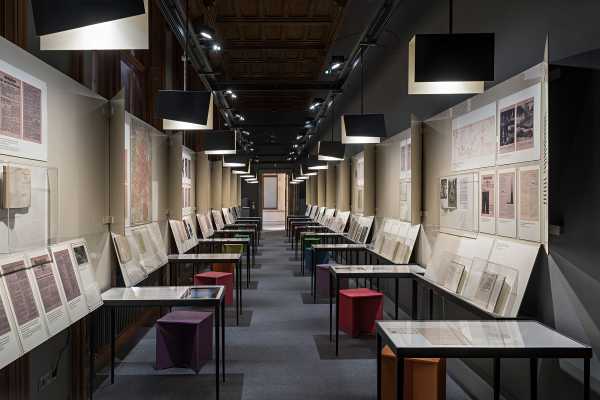
This balcony was juxtaposed with a showcase of maximum size, in which the mass of found objects is laid out in a kind of forensic arrangement, minimally presorted: on an expansive display surface – at an intermediate height, not on the floor and not at table height. The carefully sorted accumulation and order on it shows things in an intermediate state: they are no longer rubble and not yet cataloged exhibits, are now there as testimonies for criminological investigations of the Nazis’ acts of destruction. Lifted out of this, displays on higher levels show individual objects, each detached from the “residual” stock of destruction. They begin to carry their specific histories more clearly into the present. Through the lens of the moment of violence, they tell of the history of the place before its destruction: after all, Malzgasse 16 was home to Vienna’s first Jewish museum, a Talmud-Thora association school and an association synagogue. But also the present of today’s school and the excavation work at Malzgasse 16 are present in the House of History on film: a thin rear projection screen hangs vertically above the horizontal plane of the objects. In a reading niche, a collection of texts and documents provides insight into the forced use of the site by the Nazis after its destruction – as a hospital for the sick and as a collection camp. Starting from the moment of violence frozen in the rubble, the exhibition appropriately brings to visibility the things now no longer buried.